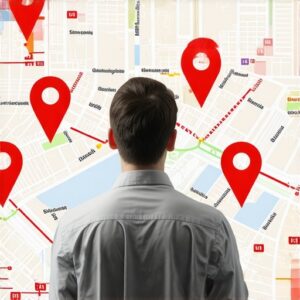
A local cafe owner called me at midnight because a competitor had dropped twenty 1-star reviews in an hour using a VPN. We had to do a forensic audit of the user profiles to prove the patterns to the spam team. This was not just a prank. It was a coordinated strike designed to trigger the algorithmic quality filters and push their legitimate business into a shadowban status. The air in my office smelled like cold coffee and wet concrete as I mapped out the IP clusters used in the attack. Local search is not a game of simple keywords. It is a spatial battlefield where proximity signals, behavioral data, and forensic trust scores dictate who survives the Map Pack. To recover, you must first identify the specific attack vector, document the statistical anomalies, and then execute a total cleanup of your digital footprint to re-establish your location authority with Google.
The midnight call that exposed a digital heist
A coordinated negative SEO attack against a local business often utilizes bot-driven review waves or malicious reporting to trigger a Google Business Profile suspension. Recovery requires a forensic audit of user profiles and IP patterns to prove to Google that the activity was fraudulent and not organic engagement. When that cafe owner called me, I knew we weren’t just looking at bad feedback. We were looking at a systematic attempt to destroy their centroid authority. We had to look at the timestamp of every review, the account age of the reviewers, and the geographic location of the devices used. The goal of the attacker is to make Google’s algorithm believe your business is either low quality or a spam entity. This is why having the professional approach to cleaning up malicious negative review waves is vital. You cannot just ignore it. You have to fight back with data. We spent nights scrubbing the profile, reporting the spam accounts, and providing the internal team with proof that these users had never physically visited the shop. We looked for the ‘glitch’ in the data. Real customers have GPS history. Bots do not. By proving the lack of physical movement, we won the appeal.
Why your physical location is a liability
Physical proximity remains the strongest ranking signal in the local algorithm, but it becomes a liability when your GPS coordinates are associated with previous spam. Google uses spatial databases to track the ‘reputation’ of a specific address, meaning a history of address rentals or fake listings at your location can drag down your ranking.
“Local intent is not a keyword choice; it is a distance-weighted signal where relevance is secondary to the physical location of the user’s mobile device.” – Map Search Fundamental
This means even if you have a perfect website, a toxic history at your physical address can prevent you from appearing in the top 3. You need to understand how removing the legacy footprints that trigger googles spam filters works to clear the air. I have seen businesses fail simply because their suite number was previously used by a lead-gen warehouse. The algorithm remembers the spatial pattern. To fix this, you must demonstrate unique occupancy. This involves updating your photos with outdoor signs, verifying your utility bills, and ensuring your NAP data is consistent across every single directory. If your pin is bouncing, it is often because Google is receiving conflicting signals about whether you actually exist at those coordinates. You might need how to fix the address errors that keep your pin from appearing at high zoom levels to stabilize your presence. Every centimeter matters when the user is searching from their mobile device in a three-block radius.
[IMAGE_PLACEHOLDER]
The forensic trace of a malicious review wave
Identifying a malicious review wave involves looking for statistical outliers in sentiment, timing, and user account metadata that deviate from your historical organic patterns. Google’s AI looks for ‘velocity bursts’ that suggest manipulation, but attackers hide inside these bursts to get your profile flagged for review removal or suspension. When you are hit, you need how to fight back against a wave of automated spam reviews by documenting the lack of ‘local justification.’ A real review usually includes a location-specific entity, such as the name of a neighborhood or a specific product mentioned in the store. Bot reviews are generic. They use phrases like ‘bad service’ without context. You need to show Google that these reviews are coming from accounts with no physical proximity to your store. This is part of a larger the recovery plan for listings targeted by negative seo attacks that every business owner should have on standby. I remember one case where the competitor used a VPN to post reviews from ten different countries. We pulled the public data on those accounts and showed they were all created on the same day. That is the smoking gun. Google loves consistency. When your profile shows a sudden deviation, the algorithm assumes you are the one cheating. You have to prove you are the victim.
Erasing the digital fingerprints of a sabotage campaign
The process of erasing the damage from a sabotage campaign requires a multi-layer cleanup of your backlink profile, citation data, and public business descriptions. Competitors often use ‘negative SEO’ by pointing thousands of toxic, adult-themed, or foreign-language links to your website to tank your organic authority and map position. You must use the guide to pruning toxic backlinks for local business owners to identify these harmful entries. Do not wait for a manual action. You should also check if someone has suggested ‘edits’ to your business hours or phone number on Google Maps. It is a common tactic to change a competitor’s hours to ‘Permanently Closed’ on a Friday afternoon. This is why you need how to recover rankings after a competitor reports your listing as permanently closed. Vigilance is the only defense. We once found a client whose ranking dropped because a competitor had uploaded twenty blurry, low-quality photos of a trash bin to their profile. Google’s AI saw the photos and lowered the quality score of the listing. We had to flag every photo and replace them with high-resolution, geo-tagged images taken from a real smartphone. This restored the ‘trust score’ of the profile. You are essentially teaching the algorithm who to trust again.
Local Authority Reading List
- Google Maps Consultants Reveal Secrets to Climb Map Rankings
- Restoring Map Pack Authority After a Cleanup of Junk Listings
- The Toolkit Every Small Business Needs for Local Map Dominance
- Why Standard SEO Audits Miss the Most Critical Local Map Signals
- How to Audit Your Business Citations for Consistency Without Paying for Monthly Tools
The three mile radius that determines your revenue
The three mile radius around your business is the primary zone where proximity signals are strongest, and any degradation in NAP consistency can cause your pin to vanish. Centroid theory explains that Google prefers to show businesses closest to the user’s geographic center, but this distance weight is often balanced against your historical reliability and site performance. If you are struggling, it is likely why your proximity signal is weaker than your closest competitor. You might be physically closer, but if your website takes five seconds to load, Google will show the guy a mile further away. You need to look into why your slow website is secretly dragging down your map ranking. The physics of local search are unforgiving. I have seen pins move three blocks and lose half their traffic because they exited a specific neighborhood polygon. To fix this, you must build ‘local justifications.’ This means getting reviews that mention your city and neighborhood by name. When a user searches for a service in their town, Google looks for the connection between your physical location and the words in your reviews. If those match, your ‘Proximity Beacon’ shines brighter. It is about closing the gap between the digital pin and the physical reality of the customer’s journey.
Why your business name is a magnet for spam
Keyword stuffing your business name with city names or service categories violates Google’s Terms of Service and makes you a target for competitors to report your listing. While it might give you a temporary boost, it creates a fragile profile that can be nuked with a single ‘Suggest an Edit’ from a rival business owner. You should focus on scrubbing away the traces of old map stuffing techniques to ensure long-term stability. If your name is ‘Plumber NYC’ but your legal name is ‘John’s Pipes,’ you are asking for a suspension. Competitors love reporting these. It is the easiest way to clear out the Map Pack. If you have been hit by this, you may need seo consulting services for complex penalty cases to navigate the reinstatement process. Google wants to see the name that is on your storefront and your tax returns. When you deviate, you lose the trust of the algorithm. I once saw a law firm lose its ranking because they added ‘Best Injury Lawyer’ to their title. A competitor reported them, and Google didn’t just remove the keywords; they suspended the entire profile for three weeks. The loss in revenue was ten times what the keyword boost provided. Stick to the truth and build authority through content and reviews instead of risky naming conventions.
The hidden cost of volatile map rankings
Map ranking volatility after a business expansion is often caused by Google re-evaluating your service area boundaries and physical location data against your new footprint. When you add a second location or expand your service area, the algorithm needs to verify that you can actually fulfill those requests without a significant delay in service. This is why you need local seo services to stabilize volatile map rankings after expansion. Many owners panic when they see their rankings bounce, but it is often just the algorithm recalibrating. However, if the bounce continues for more than a month, you have a signal problem. You should look at how to stop your map rankings from bouncing around after a business expansion. It usually comes down to ‘Local Service Area’ settings. If your polygon is too large, Google might think you are a lead-gen scam. I always tell my clients to keep their service area realistic. If you can’t drive there in forty minutes, don’t put it in your profile. Google tracks the speed of mobile devices associated with your business. If your ‘workers’ are never seen in the cities you claim to serve, the algorithm will demote you. The data doesn’t lie. It is a behavioral map that mirrors the physical world.
Tools that reveal the invisible competitors
Professional local SEO tools provide a real-time view of the ‘Map Pack’ from specific GPS coordinates, allowing you to see exactly where your ranking drops off. Standard SEO tools often give a global or city-wide average, which is useless for a business that lives or dies by a three-block radius. You need to find best toolkit to improve local search rankings that offers grid-tracking. This shows you a heat map of your visibility. If you are ranking #1 at your front door but #10 two blocks away, you have a proximity weakness. You might consider a gmb ranking toolkit buy to get these specific insights. I use these tools to find the ‘shadow competitors’ who are using fake addresses to steal your traffic. These are often virtual offices or residential homes pretending to be commercial storefronts. By using tools that actually show why you are missing from the local map pack, you can identify these spammers and report them. This is how you reclaim your territory. It is not just about what you do; it is about cleaning up the neighborhood. A clean Map Pack is a profitable Map Pack. Don’t let ghosts take your customers. Use the math to prove they don’t belong there.
Rebuilding the trust signals that Google requires
Rebuilding trust after a suspension or a negative SEO attack requires a total commitment to transparency, including the submission of high-quality video proof and legal documentation. Google is moving toward a ‘Zero Trust’ model where every business is guilty until proven local. You must be prepared with the specific documents you need to win a gmb reinstatement appeal, such as business licenses, utility bills, and proof of physical signage. If you have been partially suspended, you need seo services to fix partial suspension with limited gmb features to restore your full visibility. The algorithm needs to see that your business is a ‘Proximity Beacon’ that provides real value to the community. This involves getting authentic, human-centric reviews and posting regular updates that show real work being done. It takes time to wash away the scent of a spam attack, but with a disciplined cleanup strategy, your ranking will return. Focus on how to rebuild trust with google after a profile suspension by being the most verified business in your zip code. When the algorithm sees your consistency, it will lock your pin back into the top 3. You are not just a profile; you are a physical pillar of your local economy. Make sure Google knows it. The street photographer sees the truth in the storefront; the algorithm sees the truth in the data consistency.